Unstable valve control can increase energy use, reduce comfort, and disrupt HVAC performance. Electrothermal actuators provide reliable automated control for accurate heating and cooling management.
Electrothermal actuators are compact control devices that convert electrical energy into thermal expansion to open or close valves. Commonly used in HVAC, underfloor heating, fan coil, and hydronic systems, they support automatic temperature regulation, quiet operation, energy-efficient zone control, and integration with thermostats or building management systems.
Understanding their principles, configurations, advantages, and limitations helps project professionals select appropriate actuators for different HVAC control requirements.
What Is an Electrothermal Actuator?
An electrothermal actuator is an electrically operated device commonly installed on control valves in heating, cooling, and hydronic distribution systems.
Its main function is to regulate fluid flow automatically according to signals received from:
- Термостаты
- Зональные контроллеры
- Системы управления зданиями
- HVAC automation equipment
Unlike motorized actuators that depend on electric motors and gear mechanisms, electrothermal actuators generally use a temperature-sensitive expansion element.
When electrical power is applied, an internal heating component raises the temperature of the expansion material. The material expands and produces mechanical movement, which changes the position of the connected valve.
When power is removed, the actuator gradually cools and returns to its original position.
This operating method contributes to:
- Quiet performance
- Компактная конструкция
- Simple mechanical design
- Reduced mechanical wear
- Stable valve operation
Electrothermal actuators are particularly suitable for HVAC applications that require repeated opening and closing rather than rapid valve movement.
How Do Electrothermal Actuators Work?
A typical electrothermal actuator includes several basic components:
- Housing
- Нагревательный элемент
- Thermal expansion medium
- Piston or actuator stem
- Return spring
- Valve connection interface
When the actuator receives an electrical signal, the heating element warms the internal expansion material.
As the material expands, it pushes the actuator stem or piston. This movement operates the connected valve and regulates water flow through the HVAC circuit.
Depending on the design, an actuator may be configured as:
Нормально закрытый
The valve remains closed when the actuator is not energized and opens after electrical power is supplied.
Нормально открытый
The valve remains open without power and closes after the actuator is energized.
The correct configuration depends on the HVAC control strategy, system safety requirements, and desired valve position during a power interruption.
Because electrothermal actuators depend on heating and cooling, their response is generally slower than that of motor-driven actuators. However, many HVAC applications do not require immediate valve movement.
Gradual operation can provide stable flow regulation while reducing unnecessary mechanical impact.
Common Applications of Electrothermal Actuators
Electrothermal actuators are widely used in hydronic HVAC systems where automatic zone or terminal control is required.
1. Underfloor Heating Systems
Underfloor heating is one of the most common applications.
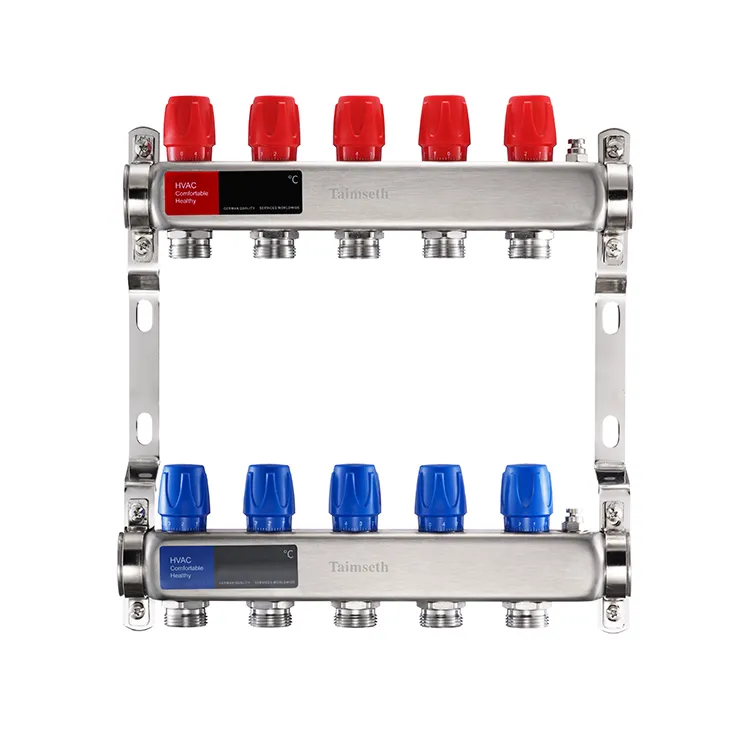
Electrothermal actuators are installed on heating manifolds to control individual water circuits. A room thermostat monitors indoor temperature and sends a control signal to the corresponding actuator.
The actuator then opens or closes the heating loop according to actual demand.
This arrangement supports:
- Individual room control
- Improved temperature stability
- Reduced unnecessary heating
- More efficient zone management
2. Fan Coil Units
Electrothermal actuators are also commonly used with fan coil units.
The actuator controls chilled-water or hot-water flow entering the fan coil. By adjusting valve position according to room temperature requirements, the HVAC system can regulate heating or cooling output more efficiently.
This application is common in:
- Офисные здания
- Отели
- Коммерческие объекты
- Apartment projects
- Public buildings
3. Hydronic Heating Systems
In hydronic heating installations, electrothermal actuators can regulate water distribution between different circuits.
Independent zone control allows the system to provide heating only where required, improving overall operating efficiency.
4. Radiator and Terminal Heating Systems
Electrothermal actuators may also be installed on radiator valves or other terminal heating equipment.
Combined with thermostats and centralized controls, they support automatic temperature regulation across different building areas.
5. Commercial HVAC Control Systems
In larger commercial projects, electrothermal actuators can operate as terminal control devices within an integrated HVAC control system.
They may work together with:
- Датчики температуры
- Комнатные термостаты
- Зональные контроллеры
- Системы управления зданиями
- Remote monitoring platforms
This creates a direct connection between indoor temperature demand and water-flow control.
Key Advantages of Electrothermal Actuators
Simple Construction
Many electrothermal actuators contain fewer moving mechanical parts than traditional motorized actuator designs.
This can simplify operation and reduce maintenance requirements.
Бесшумная работа
Electrothermal actuators generally operate with limited mechanical noise.
This characteristic is particularly valuable in environments such as:
- Offices
- Отели
- Жилые здания
- Healthcare facilities
- Educational buildings
Compact Size
Their compact structure makes electrothermal actuators suitable for installations where available space is limited, particularly around manifolds and terminal HVAC equipment.
Energy-Efficient Zone Control
When connected to thermostats or centralized controllers, actuators can regulate individual heating and cooling zones independently.
This allows HVAC systems to supply heating or cooling according to actual demand rather than operating all areas continuously.
Integration With HVAC Automation
Electrothermal actuators can form part of broader intelligent HVAC control strategies.
Jinyi HVAC emphasizes energy-efficient system design, zone management, customized control strategies, BMS integration, and remote monitoring within its industrial and commercial HVAC solutions. These system-level control concepts are relevant when integrating valve actuators into complete HVAC installations.
Important Selection Considerations
Selecting an electrothermal actuator requires more than matching its physical size with a valve.
Several technical factors should be reviewed.
Совместимость клапанов
The actuator must match the selected valve in terms of:
- Connection type
- Thread size
- Stroke
- Operating force
- Mounting dimensions
Incorrect matching can result in incomplete valve movement or installation problems.
Supply Voltage
The actuator voltage must correspond to the electrical design of the HVAC control system.
Voltage requirements should therefore be confirmed before procurement and installation.
Normally Open or Normally Closed Design
The appropriate configuration depends on how the HVAC system should operate when electrical power is unavailable.
This decision should be considered during system design rather than after equipment selection.
Operating Time
Electrothermal actuators generally operate more slowly than motorized actuators.
They are therefore more appropriate for applications where gradual valve movement is acceptable.
Environmental Conditions
Project designers should also evaluate:
- Ambient operating temperature
- Moisture conditions
- Required enclosure protection
- Expected operating cycles
- Условия установки
Control System Compatibility
The actuator must work correctly with the thermostat, zone controller, or building automation system used in the project.
Clear technical documentation helps avoid incompatibility during installation and commissioning.
Electrothermal Actuators in Intelligent HVAC Systems
Modern HVAC projects increasingly rely on integrated control rather than isolated mechanical equipment.
In a typical control sequence:
Sensor → Controller → Electrothermal Actuator → Valve → Water Flow → Indoor Temperature
A temperature sensor detects indoor conditions.
The controller compares the measured temperature with the target value and determines whether heating or cooling is required.
The electrothermal actuator then operates the corresponding valve and regulates water flow through the circuit.
This process helps connect actual building demand with HVAC operation.
For industrial and commercial projects, actuators should therefore be evaluated as part of the complete system control architecture.
Jinyi HVAC states that its customized HVAC solutions can incorporate energy-saving controls, BMS integration, remote monitoring, installation guidance, commissioning, and long-term maintenance support. Such integrated planning is important when developing reliable control arrangements for complex facilities.
Заключение
Electrothermal actuators provide compact, quiet, and reliable valve control, supporting efficient zoning, automated temperature management, and modern HVAC system integration.