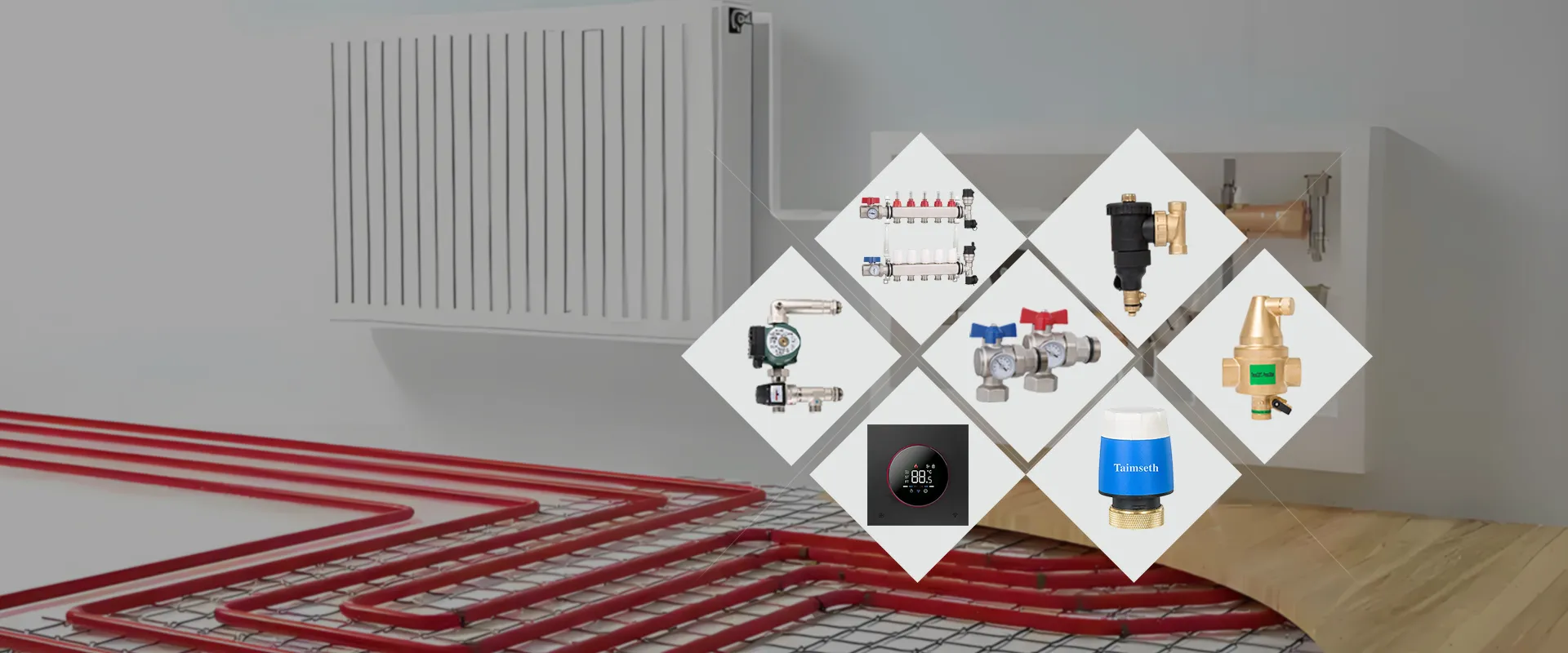
Unstable room temperatures reduce comfort and increase energy waste. Poor zone control can raise operating costs. Thermal actuators provide an effective way to regulate HVAC water flow.
Thermal actuators control room temperature by opening or closing HVAC valves according to thermostat signals. When temperature moves away from the setpoint, the actuator adjusts heating or cooling water flow. This enables automatic zone control, helps maintain stable indoor temperatures, and can reduce unnecessary energy consumption in hydronic HVAC systems.
To use thermal actuators effectively, it is important to understand how they work, where they are applied, and how to select them.
Was ist ein thermischer Aktuator?
A thermischer Antrieb, also called an electrothermal actuator, is an electrically operated device used to control valves in heating and cooling systems.
It is commonly installed on:
- Radiator valves
- Verteiler für Fußbodenheizungen
- Fan coil valves
- Hydronic zone valves
- Heating and cooling distribution circuits
Inside the actuator, an electrical heating element warms an expansion material. As the material heats, it expands and creates mechanical movement.
This movement pushes or releases the valve stem, changing the amount of water flowing through the HVAC circuit.
When electrical power is removed, the actuator cools and gradually returns to its original position.
Because thermal actuators operate using gradual thermal expansion rather than a high-speed motor, they are particularly suitable for applications where temperature changes occur relatively slowly.
How Do Thermal Actuators Control Room Temperature?
A thermal actuator usually does not measure room temperature directly.
Instead, it works together with a room thermostat, temperature sensor, zone controller, or building management system.
A typical control sequence follows four steps:
- The thermostat measures room temperature.
- The controller compares the temperature with the setpoint.
- The thermostat sends a signal to the thermal actuator.
- The actuator opens or closes the valve to regulate water flow.
For example, if a room becomes colder than the required temperature, the thermostat can activate the heating circuit.
The actuator then opens the relevant valve, allowing hot water to pass through the radiator, floor heating loop, or fan coil.
Once the room approaches the target temperature, the controller changes the signal and reduces or stops water flow.
This process allows each room or zone to receive heating or cooling according to actual demand.
Why Use Thermal Actuators for Room Temperature Control?
Thermal actuators are widely used because they support individual zone control.
Different areas of a commercial or industrial building can have very different heating and cooling requirements.
Temperature demand may vary because of:
- Number of occupants
- Solar heat gain
- Equipment operation
- Building orientation
- Room size
- Working schedules
- Insulation conditions
Without zone control, one HVAC setting may cause some rooms to become too warm while others remain too cold.
Thermal actuators allow separate zones to respond independently to their own temperature requirements.
More Stable Indoor Temperature
By regulating water flow according to thermostat demand, thermal actuators help maintain temperatures closer to the required setpoint.
Improved Energy Efficiency
When a room reaches the required temperature, the actuator can restrict unnecessary heating or cooling water flow.
This can reduce energy waste and improve overall HVAC operating efficiency.
Independent Zone Control
Each office, meeting room, production area, or building zone can operate according to its own temperature setting.
Automatic Operation
Once integrated with thermostats or controllers, thermal actuators can operate automatically without continuous manual adjustment.
Normally Closed vs. Normally Open Thermal Actuators
Thermal actuators are commonly available in normalerweise geschlossen (NC) und normalerweise offen (NO) versions.
| Type | Default Position | Typical Behavior |
|---|---|---|
| Normally Closed (NC) | Ventil bleibt ohne Strom geschlossen | Power activates the actuator to open or regulate the valve |
| Normally Open (NO) | Ventil bleibt ohne Strom offen | Power activates the actuator to close or regulate the valve |
The correct option depends on the HVAC control strategy.
Engineers should consider:
- Required valve position during power failure
- Heating or cooling system design
- Sicherheitsanforderungen
- Energy management strategy
- Controller compatibility
- Building operating conditions
Neither configuration is automatically better for every application.
What Should Be Considered When Selecting a Thermal Actuator?
Selecting the correct actuator requires more than choosing the operating voltage.
Several technical factors should be checked.
1. Valve Compatibility
The actuator must match the valve connection and operating characteristics.
Important parameters include:
- Connection size
- Valve stem dimensions
- Required stroke
- Closing force
- Mounting method
2. Operating Voltage
Common thermal actuators may operate at voltages such as:
- 24 V
- 230 V
The actuator voltage must match the thermostat, controller, and electrical design.
3. Normally Open or Normally Closed
The selected operating mode should correspond with the required system behavior during normal operation and power interruption.
4. Response Time
Thermal actuators do not normally open or close instantly.
The internal expansion material requires time to heat and cool, so response time should be considered when designing the control sequence.
5. Control System Integration
The actuator should be compatible with the intended control system, including:
- Raumthermostate
- Zone controllers
- Gebäudemanagementsysteme
- Central HVAC controllers
- Remote monitoring systems
Can Thermal Actuators Work with a BMS?
Yes.
Thermal actuators can be integrated into a broader Gebäudemanagementsystem (BMS) through compatible thermostats, controllers, and control modules.
A BMS can coordinate multiple zones and monitor factors such as:
- Room temperature
- Heating demand
- Cooling demand
- Valve status
- Fahrpläne
- Energy consumption
This is particularly useful in commercial and industrial buildings with many independently controlled spaces.
Jinyi HVAC provides industrial and commercial HVAC solutions that can include customized system layouts, zone management, BMS integration, intelligent controls, and remote monitoring according to project requirements.
Where Are Thermal Actuators Commonly Used?
Thermal actuators are suitable for many hydronic heating and cooling applications, including:
- Bürogebäude
- Commercial complexes
- Hotels
- Industrial facilities
- Lagerhäuser
- Residential buildings
- Fußbodenheizungen
- Fan coil systems
- Zoned heating networks
Their suitability depends on valve design, response requirements, control strategy, and overall HVAC system configuration.
Are Thermal Actuators Suitable for Every HVAC Application?
Not necessarily.
Thermal actuators are highly practical for room and zone temperature control, but some applications may require faster or more precise valve positioning.
Alternative actuator technologies may be more appropriate when a system requires:
- Very fast valve movement
- Continuous proportional positioning
- High operating force
- Complex modulation
- Specialized industrial control
Therefore, actuator selection should be based on the complete HVAC system rather than on the valve alone.
Valve characteristics, control logic, water flow requirements, electrical specifications, temperature control accuracy, and system operating conditions should all be evaluated together.
Schlussfolgerung
Thermal actuators provide reliable zone temperature control by regulating HVAC water flow, helping improve indoor comfort, system efficiency, and automated operation.